Data
The images medicine said you would never see
Severe coronary disease reduced on CT, without surgery or drugs. Calcium scores falling. These are human arteries, imaged by independent radiology practices, and every image here appears in a Cholrem paper that is published or in peer review.
Case report, 2026 (in peer review)
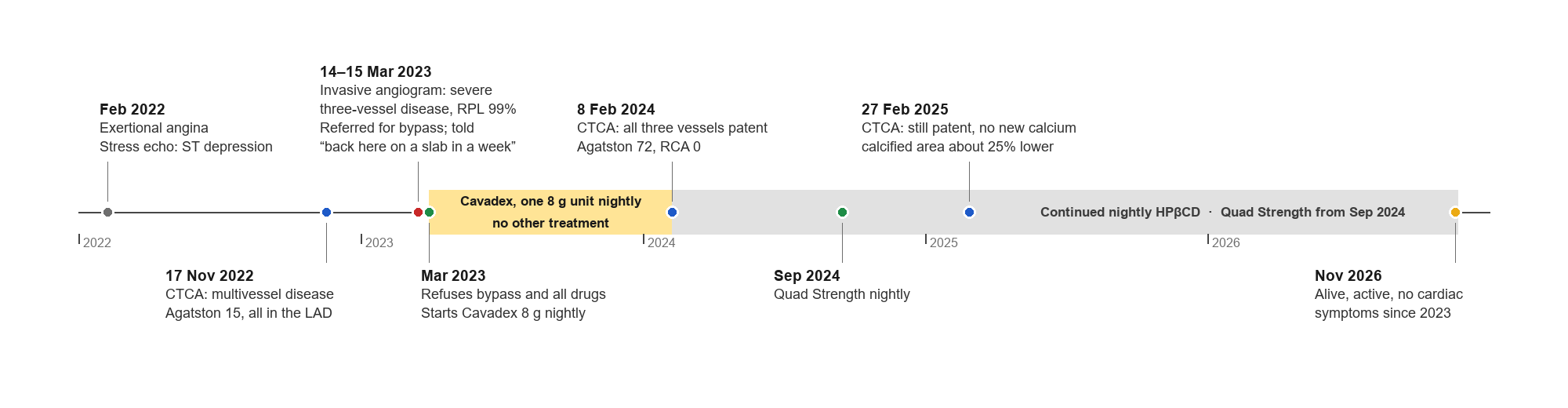
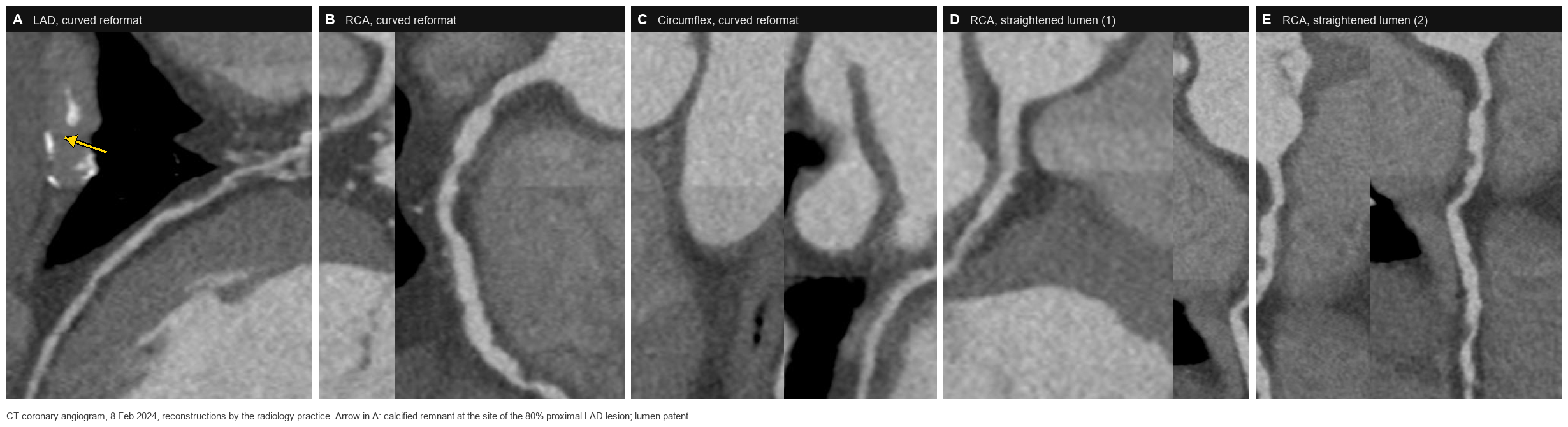
Three-vessel coronary disease, bypass declined, arteries patent eleven months later
A man in his late fifties had an invasive coronary angiogram in March 2023 showing an 80% blockage in the left anterior descending artery, 70% in the circumflex, tandem 70% and 90% blockages in the right coronary artery and a 99% blockage in a posterolateral branch. The hospital’s surgical clinic recorded severe three-vessel disease, wrote “strongly recommend CABG” (bypass surgery), offered the operation within thirty days and warned of the “possibility of fatal heart attack or sudden death”. He declined the surgery and every prescribed medication, and used Cavadex nightly instead.

What the case shows
- Stenoses of 70–99% in all three coronary territories reduced to patent vessels on CT within eleven months.
- No surgery, no statin, no antiplatelet, no nitrate. One intervention.
- Calcium behaved exactly as Cholrem predicted: a rise as soft plaque was cleared, then decline.
- Two years on, the patient is well and the arteries remain open.
I was told I would be back on a slab within a week.
Full case report under peer review. Patient identifiers removed. DICOM series available to qualified researchers under agreement.
Across the published papers
A consistent pattern, paper after paper
Coronary angiograms before and after
The founder received intravenous HPβCD for 36 days. Repeat coronary angiography showed the narrowing in his right coronary artery reduced, and his cardiologist’s advice changed from a stent to medical management. The first human arterial imaging for the molecule anywhere.
Carotid plaque and lipids
A second intravenous course reduced carotid plaque on ultrasound within weeks, with falls in cholesterol and triglycerides and improved liver function markers.
125 people, 12 weeks
A self-monitored observational study reporting symptomatic improvement and better quality of life across the cohort.
Case series: plaque regression and symptoms
Coronary, carotid and peripheral cases with imaging before and after, alongside symptom change.
High-viscosity formulation case series
Multi-patient retrospective series on the current formulation, with coronary, peripheral and carotid regression documented.
Coronary calcification regresses
Longitudinal, scanner-matched calcium scores falling in the majority of tracked patients, challenging the paradigm that coronary calcification is irreversible.
The numbers, paper by paper
| Finding | Source |
|---|---|
| Coronary narrowing 82% to 24% on CT angiography in six months | 2026 high-viscosity series |
| A 70% LAD narrowing reduced to 27% in four to five months | 2025 case series |
| Calcium score 207 to 89 in 13.8 months, same scoring software | 2026 calcification paper |
| Calcium score 594 to 521 in 75 days | 2026 calcification paper |
| Calcium rose untreated, fell on treatment, rose again when treatment stopped | 2026 calcification paper |
| 18 of 20 patients with angina improved | 2025 case series |
| 88% of final respondents reported better overall health at 12 weeks | 2025 observational study |
| Triglycerides 20 to 4.9 mmol/L in eight weeks | 2021 intravenous study |
The calcium scores above come from radiology reports signed by independent radiologists. The scans were performed by independent hospitals and radiology practices. Reports and scan files are available to qualified readers under agreement.
The data engine
Thousands of users. A registry built to learn from them.
Cholrem’s member registry collects lipid panels, blood pressure, calcium scores, imaging and symptom diaries from users over years of therapy. It is the largest real-world dataset on systemic HPβCD in cardiovascular disease anywhere, and it grows every month.